
To introduce a controlled quantity of dry product into a production line, a dosing system adapted to the characteristics of the material and the required flow rate must be used.
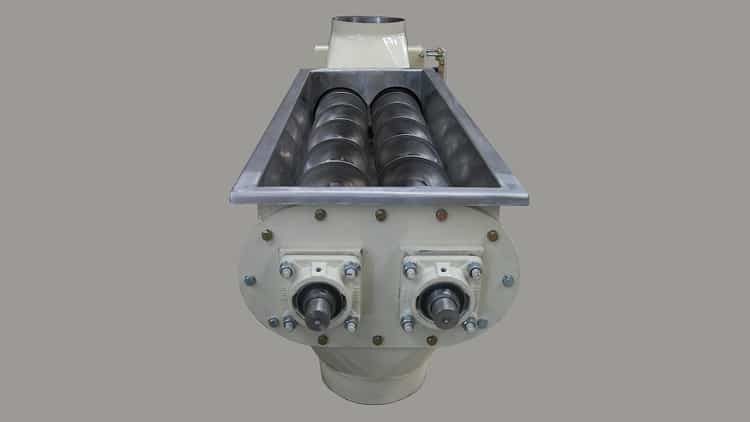

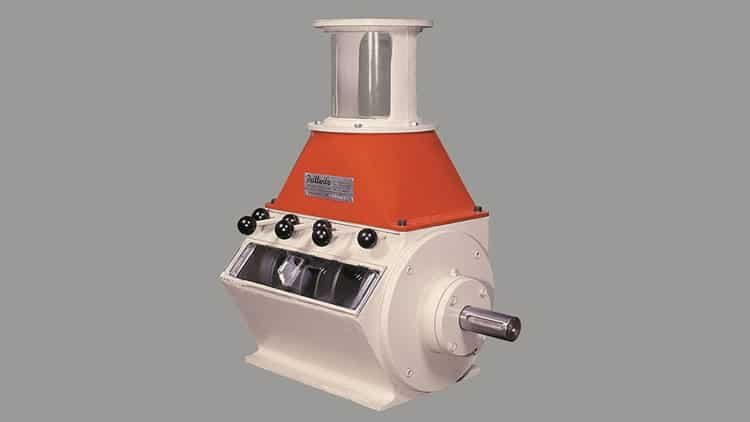
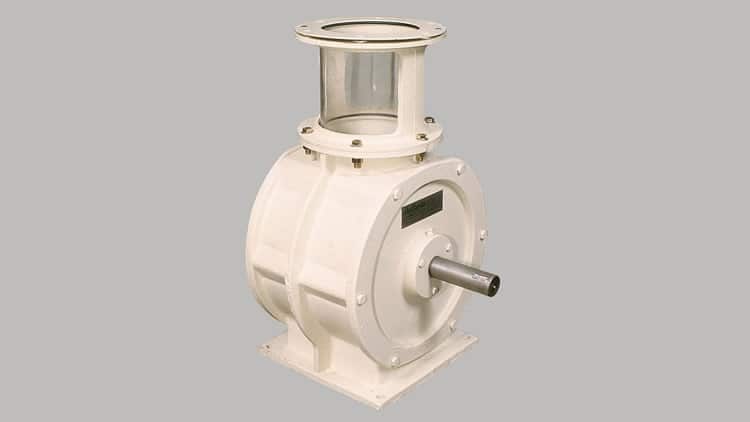
Prillwitz develops systems for the continuous dosing of powdered and granular products. The appropriate solution depends, among other factors, on particle size, bulk density, flowability, moisture content and the amount of product to be dosed.
Types of dry product dosing
Dosing systems can mainly be divided into two groups:
Volumetric dosing
Volumetric dosing regulates the volume of product supplied per unit of time, normally expressed in litres per hour.
The flow rate is controlled by changing the rotational speed of the dosing element through a variable-frequency drive. To achieve stable feeding, the dosing unit must receive the product continuously and uniformly.
When bulk density, moisture content, particle size or the way in which the product fills the dosing unit changes, the number of kilograms being dosed may also vary, even when the supplied volume remains constant.
Gravimetric dosing
Gravimetric dosing directly controls the mass of product supplied per unit of time, normally expressed in kilograms per hour.
The system incorporates load cells and a controller that continuously measures changes in weight. The measured value is compared with the programmed flow rate and, when necessary, the speed of the dosing unit is automatically adjusted.
This system compensates for variations in bulk density or product behaviour and provides a more accurate dosing process.
Components of a dosing system
01- Fluidizers
02- Screw conveyor
03- Variable-frequency drive
04- Electrical control panel
05- Level sensor
06- Weighing system
To achieve stable and accurate dosing, two main components are normally required:
- The dosing unit
This is the equipment responsible for regulating the quantity of product introduced into the process.
Depending on the product and the required flow rate, the following equipment may be used:
The dosed quantity is mainly regulated by changing the rotational speed of the equipment.
For applications requiring continuous and controlled feeding, Prillwitz generally uses dosing systems based on screw feeders or rotary valves.
- The dosing-unit feeding system
The dosing unit must receive the product continuously and without interruption. If the material forms bridges, cavities or deposits inside the hopper or silo, feeding may become irregular and affect the accuracy of the system.
Depending on the characteristics of the product, the following devices may be incorporated:
- vibrating extractors;
- agitators or stirring devices;
- fluidisers;
- hopper vibrators;
- specially designed hoppers and transitions.
Differences between volumetric and gravimetric dosing
In a volumetric system, the amount supplied mainly depends on the volume displaced during each revolution and the rotational speed of the dosing unit. It is a simple and reliable solution when the product has relatively consistent characteristics.
However, if the bulk density of the material changes, the same number of litres may represent a different number of kilograms.
In a gravimetric system, the product or the complete dosing assembly is supported on load cells. The controller calculates the mass flow rate from the change in weight and automatically adjusts the speed of the dosing unit to maintain the programmed value.
For this reason, gravimetric dosing is particularly suitable when the amount of product introduced into the process must be controlled with greater accuracy.
Which dosing system should be used?
Volumetric dosing is generally suitable when:
- the product has a relatively stable bulk density;
- a certain variation in mass flow rate is acceptable;
- a simple control system is required;
- the process can be calibrated periodically.
Gravimetric dosing is more suitable when:
- a precise quantity in kilograms per hour must be dosed;
- the bulk density of the product may vary;
- dosing directly affects a formulation or recipe;
- product consumption must be recorded, controlled or automated.
The all-in-one dosing unit
For medium and low dosing capacities, we have developed a compact machine that combines and integrates all the components required to achieve accurate, stable and reliable volumetric or gravimetric dosing.

Micrometric dispenser DMCA
The Micron metering feeder DMCA is used for micron metering of dry material. Our feeder has been specially designed to ensure accuracy and continuity
Some common raw materials in this process:
- Wheat
- Maize
- Oats
- Coffee
- Cocoa
- Rye
- Beat
- Rice
- Girassol
- Chickpeas
- Soybeans
- Peanuts
- Peanuts
- Spices
- Balanced feed
- Pellets or feeds
- Crystalline sugar
- Impalpable sugar
- Cocoa
- Coffee
- Coriander
- Curcuma
- Gelatin
- Bone meal
- Fish flour
- Milk powder
- Dried beans
- Bread crumbs
- Batter
- Aluminum powder
- Atrazine
- Bentonite
- Borax powder
- Lime
- Caolin
- Activated carbon
- Calcium carbonate
- Cement
- Shell
- Quartz
- Titanium Dioxide
- Dolomite
- Fertilizers
- Monoammonium Phosphate
- Diammonium Phosphate
- Tricalcium Phosphate
- Mica
- Refractory Materials
- Sodium naphthalenesulfonate
- Pigments
- Soaps
- Salt
- Precipitated silica
- Caustic soda
- Magnesium sulfate
- Zinc sulfate
- Tanine
- Diatomaceous Earth
- Dyes
- Gypsum
- Lithium
- Afrecho and afrechillo
- Wheat semolina and semolina
- Semolina
- Rebasillo
- Zootechnical flour
- Maize semolina
- Semolina
- Polenta
- Wheat flour, corn flour, soy flour, etc.
- Germ
- Starch
- Hull
- Polycarbonate
- Vinyl polyvinyl chloride or PVC
- Polystyrene or PET
- Polyethylene
- Polypropylene
- Expanded polystyrene (Styrofoam)
- Sawdust
- Wood
- Cork
- Soap poder
- Pigments